Vol. 10 No. 02 (2025): December - Sri Lanka Journal of Indigenous Medicine (SLJIM)
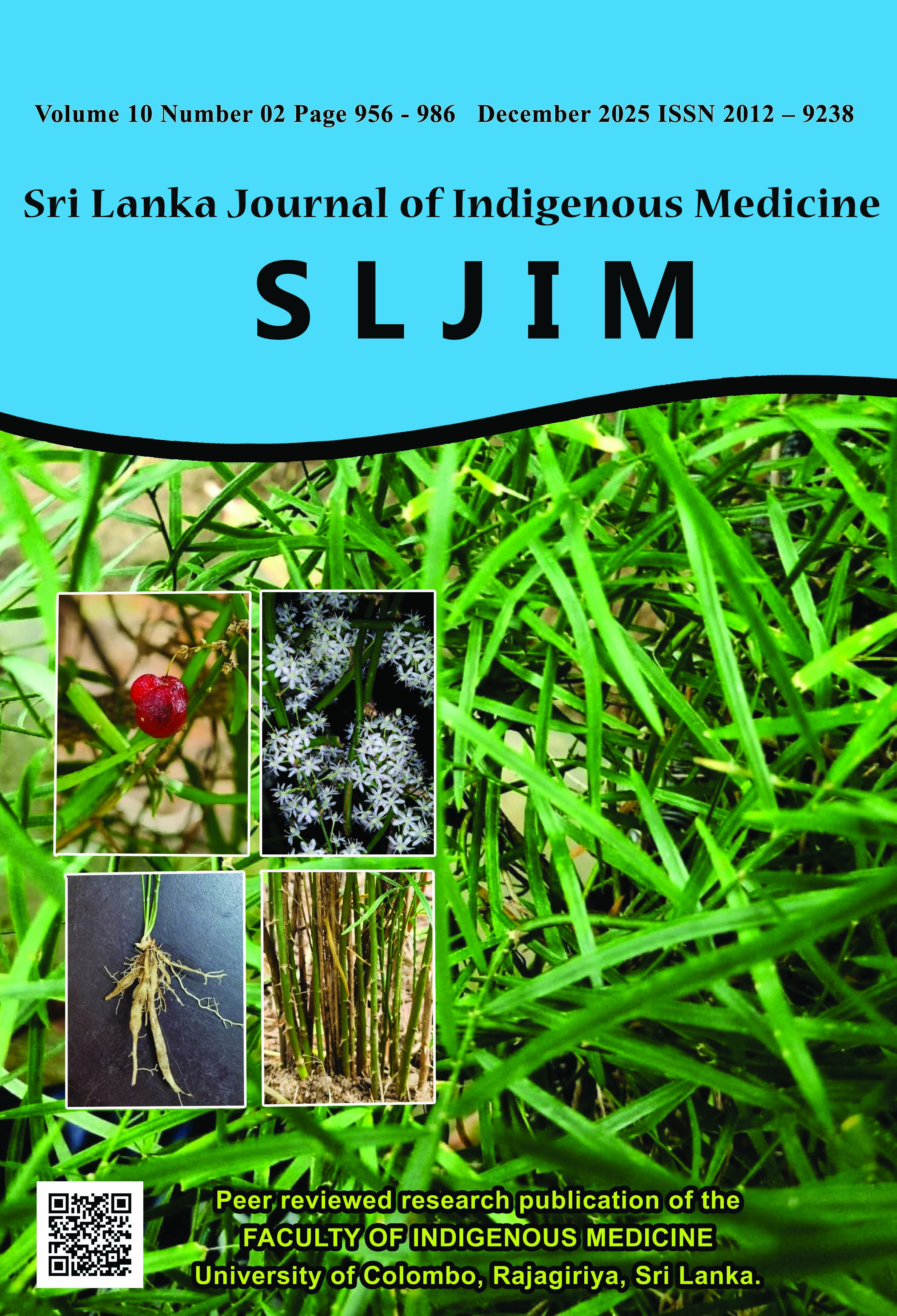
Cover story
Hatawariya
Botanical name: Asparagus racemosus
Family: ASPARAGACEAE
Vernacular names: Sinhala: Hatawariya; Sanskrit: Satavari; English: Wild Asparagus; Tamil: Shatavali, Thaneervittan, Kilangu; Hindi: Shatavari; Urdu: Satavar
Asparagus racemosus, often referred to as Shatavari, is a valued medicinal herb in both Ayurvedic and Unani traditional practices. This climbing, prickly bush flourishes in tropical and subtropical regions, typically located in sandy or loamy soil. It features small, white blossoms and tuberous roots, which serve as the main source of its healing qualities1.
A. racemosus is common throughout Sri Lanka, India and the Himalayas. A. racemosus is a woody climber growing to 1-2 m in height. The leaves are like pine needles, small and uniform and flowers are white and have small spikes1. A. racemosus and has been specially recommended in cases of threatened abortion and as a galactogogue. It is also beneficial in female infertility to increases libido and cures inflammation of sexual organs, Enhance folliculogenesis and ovulation, prepares the womb for conception, prevents miscarriages, acts as post-partum tonic by increasing lactation and normalizing the uterus and the changing hormones2. Root of A. racemosus has been referred as bitter-sweet, emollient, cooling, nervine tonic, constipating, galactogogue, and aphrodisiac, diuretic, rejuvenating, carminative, stomachic, and antiseptic and as tonic3. Phytochemically, ethanolic root extract of A. racemosus revealed the presence of alkaloids, flavanoids, tannins, phytosterols, glycosides, carbohydrates, proteins and fats. This plant also contains vitamins (A, B1, B2, C, E) and minerals (Mg, P, Ca, Fe) and folic acid4.
References
1. Siddiqui, M. S., & Pandey, A. Botanical description and medicinal significance of Asparagus racemosus: A review. Asian Journal of Pharmaceutical and Clinical Research, 2020; 13(2): 20-27
2. Nitin B. Chavhan, Twinkal Golhar, Vaibhav P. Uplanchiwar, Vinod M. Thakare Vaibhav Petkar. Shatavari (Asparagus racemosus Wild): a review on its cultivation, Morphology, biological activities & Pharmacological importance. JETIR, 2023; 10(3):232-240
3. Sairam KS, Priyambada NC, Goel RK. Gastroduodenal ulcer protective activity of Asparagus racemosus. An experimental, biochemical and histological study. J Ethnopharmacol, 2003;86(1): 1-10
4. Lokesh Kumar, Divya Mahesh, Harshada Dhiraj, Nikita Nago, Shivanee Santosh, Mohit Dnyaneshwar. A Review on Asparagus racemosus (Shatavari). International Journal of Research Publication and Reviews, 2024; 5(2): 1808-1816
Cover story by Prof. M.U.Z.N. Farzana
Photographed by Mr. G.S.K. Perera and Prof. R.D.H. Kulatunga
Cover page designed by Mr. K.K.P.R.K. Kohombakanda
Published:
2026-01-27